





Table of Contents
Property management in Trinidad and Tobago has reached a critical inflection point. The residential rental market remains robust, with stable demand particularly in urban centres like Port of Spain and San Fernando. However, the commercial sector tells a more complex story. Following economic volatility tied to energy sector fluctuations, vacancy rates in Class A and Class B office buildings have climbed as high as twenty-five percent in some markets, while rental rates have contracted by up to one-third since the oil price downturn that began in 2014.
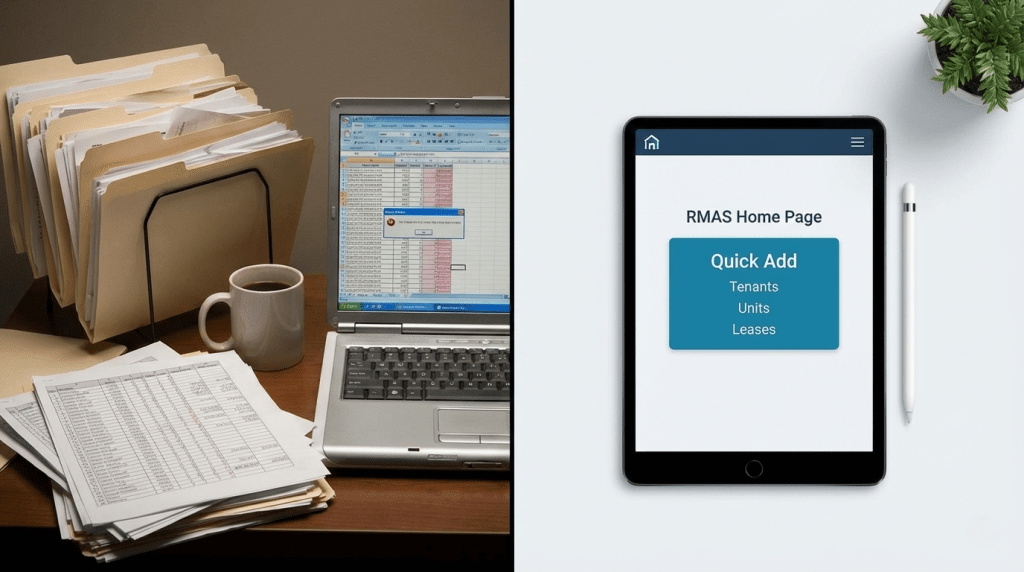
For landlords and property managers navigating this dynamic environment, the traditional approach to portfolio management has become a liability rather than an asset. The reality is stark: most property owners still rely on spreadsheets scattered across multiple devices, manila folders stuffed with lease agreements, and email, WhatsApp, and messaging chains that serve as makeshift arrears tracking systems. When a tenant calls about their lease expiration date, property managers find themselves frantically searching through documents. When preparing monthly financial reports, they spend hours manually consolidating data from disparate sources. When arrears begin accumulating, the warning signs often appear too late for proactive intervention.
The local regulatory landscape adds additional complexity. The Real Property Act and the Common Law establish the foundation for property rights and transactions, creating a legal environment where documentation and compliance carry significant weight. More recently, the Finance Act, 2025 introduced a requirement for landlord registration and an accompanying landlord business surcharge. Property owners must navigate these legal frameworks while managing the practical realities of tenant relationships, maintenance obligations, and financial performance tracking.
Trinidad and Tobago’s property management challenges are further compounded by specific local market dynamics. High-end residential properties, which once commanded exorbitant rental rates quoted in United States Dollars (USD), have seen sustained pressure since the exodus of the expatriate community began in 2015. The pandemic accelerated trends toward hybrid work arrangements, fundamentally reshaping commercial rental demand and forcing landlords to offer smaller spaces, rental rebates, and unprecedented concessions just to maintain occupancy. The Housing Development Corporation’s recent collection drive aimed at collecting TTD $241.7M of outstanding arrears underscores the magnitude of the delinquency challenges facing both public and private sector landlords.
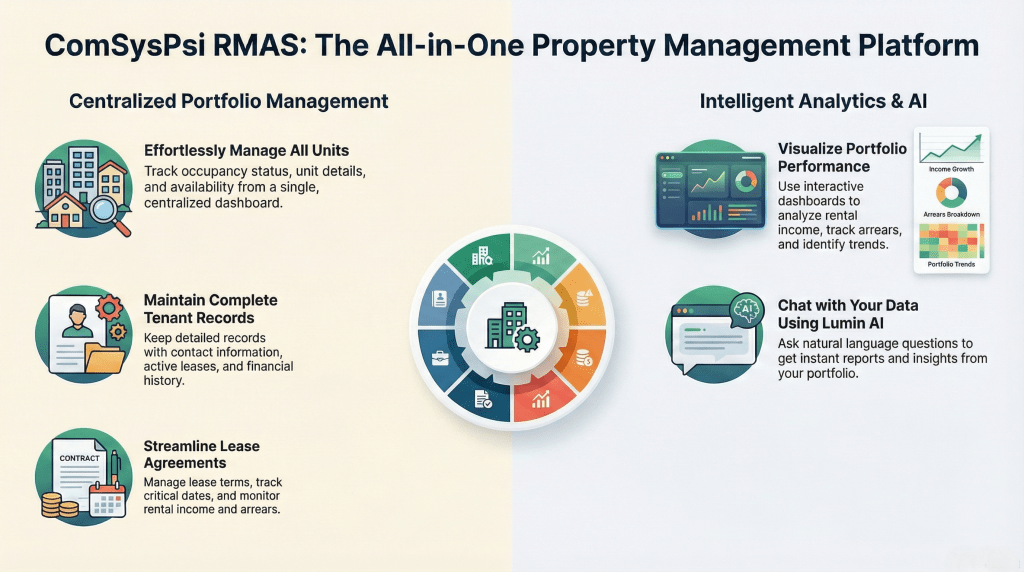
ComSysPsi RMAS represents a fundamental reimagining of property management for the Caribbean context. Built by Caribbean software and artificial intelligence engineers who understand the nuances of the local market, RMAS transforms property portfolio management from a reactive, document-chasing exercise into a proactive, intelligence-driven operation. This is not simply property management software. This is a unified property management platform that brings structure, visibility, and strategic foresight to every aspect of your rental operations.
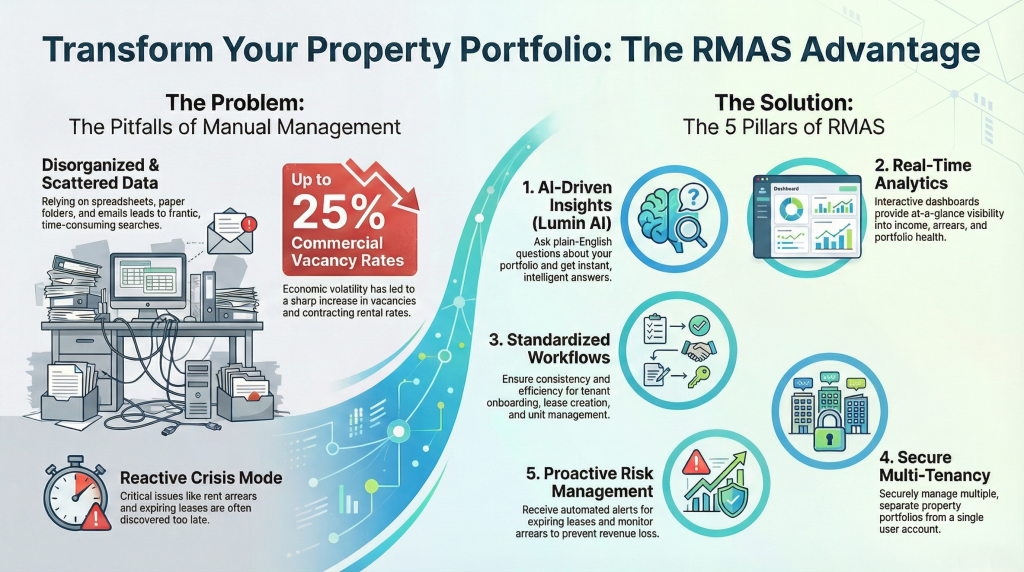
ComSysPsi RMAS is architected around five integrated pillars that work in concert to deliver comprehensive portfolio control. Unlike traditional property management solutions that bolt together disconnected features, RMAS was designed from inception as a unified intelligent platform where each pillar strengthens and informs the others.
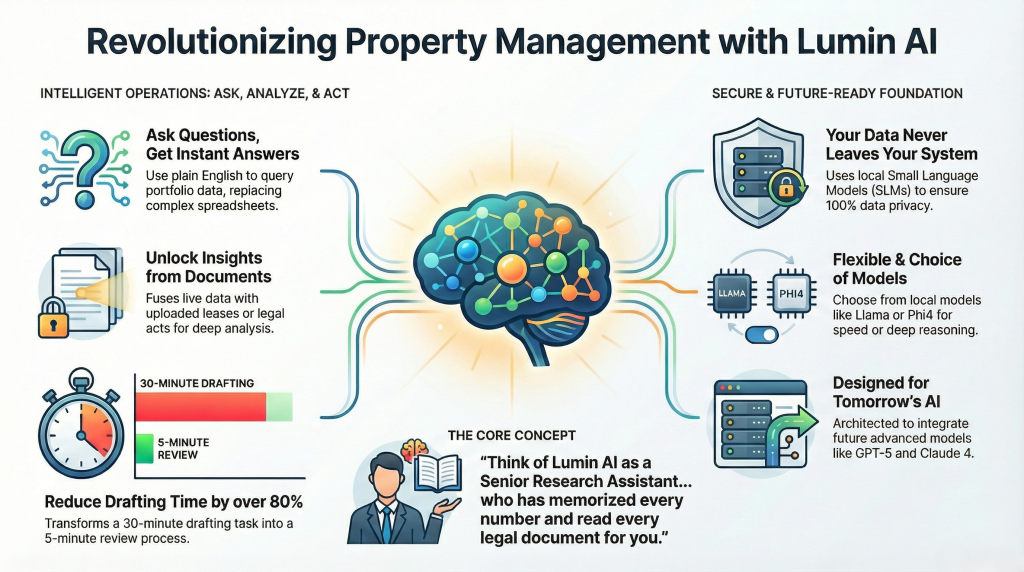
At the heart of RMAS sits Lumin AI, your conversational data expert that fundamentally changes how you interact with your property information. Rather than spending hours constructing complex database queries or pivot tables to answer business questions, you simply ask Lumin in natural language and receive immediate, context-aware answers.
Consider a typical scenario. It’s the first week of the month, and you need to identify which tenants have arrears exceeding two months so you can prioritize collection efforts. In the traditional spreadsheet world, this means opening multiple files, filtering columns, cross-referencing lease dates, and manually compiling a list. With Lumin AI, you type:
Show me all tenants with arrears greater than two months.
Within seconds, you receive a complete table showing tenant names, unit identifiers, exact arrears amounts, and the number of months each tenant is behind.
But Lumin AI’s capabilities extend far beyond simple data retrieval. The system employs Retrieval-Augmented Generation technology, which means it can analyse not only your live property data but also any documents you upload to your account. This is particularly powerful for assisting with understanding complex legal documents such as lease agreements and regulations. For example, upload a PDF copy of the Real Property Act, and Lumin can reference specific sections when analysing your lease terms. Upload your standard lease agreement template, and Lumin can draft tenant-specific renewal notices that incorporate the exact language from your contracts while personalizing details based on each tenant’s payment history and lease terms.
The practical applications are transformative. Property managers can ask questions such as: “What are the renewal terms in the lease agreement for Unit 305?” and receive accurate answers extracted from the actual lease agreement, combined with real-time data about that tenant’s current arrears status and payment history. This fusion of document intelligence and live operational data creates a level of insight that simply cannot be achieved through manual document review or traditional database queries.
Lumin AI leverages Small Language Models or (SLMs) that run locally on our servers, which means your sensitive tenant and property data, and proprietary documents never leave your secure environment. In an industry where tenant privacy and data security are paramount, this local processing architecture provides enterprise-grade protection. Future releases will integrate advanced models from leading artificial intelligence providers including GPT-5 from OpenAI, Claude from Anthropic, and Gemini from Google, giving you access to cutting-edge language models while maintaining your data security standards.
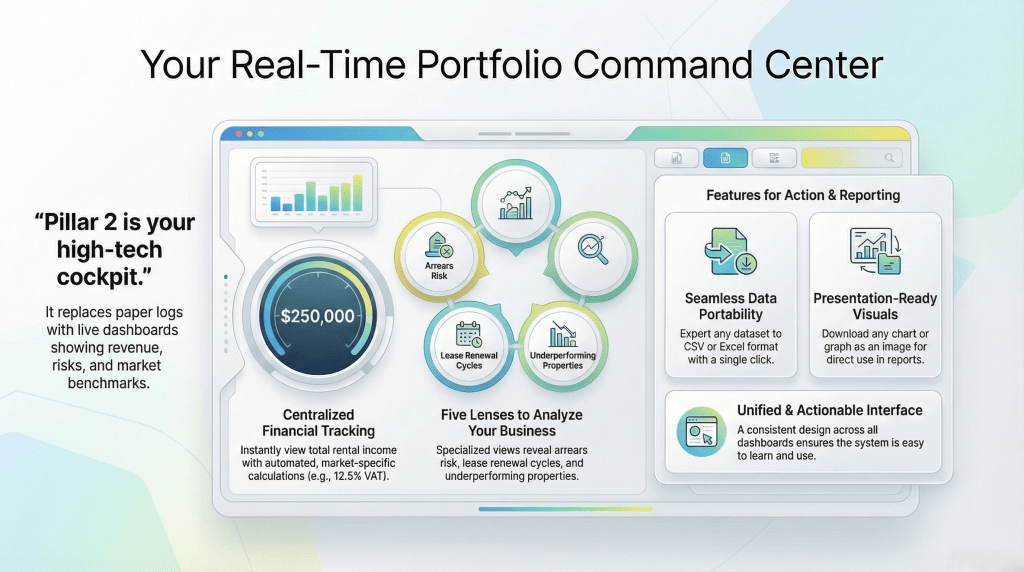
Raw data holds little value until it becomes actionable insight. RMAS transforms your property portfolio data into interactive analytics dashboards that reveal patterns, risks, and opportunities at a glance. The platform provides five specialized analytical views, each designed to illuminate a different dimension of portfolio performance.
Registered users once logged in land on their Primary Company’s Home Page, which serves as your command centre and provides direct access to all RMAS features. The platform includes 5 Analytics Dashboards. The Main Dashboard presents key portfolio performance indicators through interactive visualizations. The dashboard’s interactive visualizations provide data analysis and visualization of total rental income both VAT-exclusive, and VAT-inclusive (including the 12.50% Value Added Tax that applies to rental income in Trinidad and Tobago). The dashboard breaks down rental income by tenant, allowing property owners and managers to quickly identify their highest-revenue units and tenants. All data visualizations support multiple chart types including bar, line, and pie charts, with hover tooltips that provide detailed values, and the ability to download any chart as an image for use in reports and presentations.
The Tenant Summary table at the bottom of the Main Dashboard provides a tabular breakdown of every tenant relationship and provides information on rental units, rental amounts, current arrears balances, and payment status by tenant. The table supports sorting by any column, searching for specific tenants, and pagination through larger portfolios. Most importantly, you can export the entire dataset to CSV or Excel format with a single click, enabling offline analysis or integration with external accounting systems.
The Arrears Analysis Dashboard focuses specifically on the financial health dimension that keeps landlords awake at night. The dashboard features automated data visualizations of your portfolio’s total arrears compared to total rental income in addition to visual analysis of the number of months tenants are behind in arrears by tenant. The tenant-specific months-in-arrears chart highlights exactly which tenants represent the highest collection risk, sorted by severity. This visibility enables landlords and property managers to prioritize collection efforts strategically rather than reactively chasing whatever late payment happens to catch your attention.
Three additional specialized dashboards provide deep analytical capabilities. The Lease Term Analysis Dashboard analyses the distribution of lease durations across your portfolio, helping you understand turnover patterns and plan for renewal cycles. The Rent Per Square Foot Analysis Dashboard benchmarks rental rates across units, identifying underperforming properties that may warrant rent adjustments or repositioning strategies. The Unit Size Analysis Dashboard visualizes your portfolio composition by square footage, supporting strategic decisions about whether to divide larger units or combine smaller ones based on market demand.
Every dashboard maintains the same user-friendly features: interactive charts, sortable data tables, robust search and filtering capabilities, and one-click export to CSV or Excel. This consistency means your team can quickly become proficient with the analytical tools and apply those skills across all dimensions of portfolio analysis.
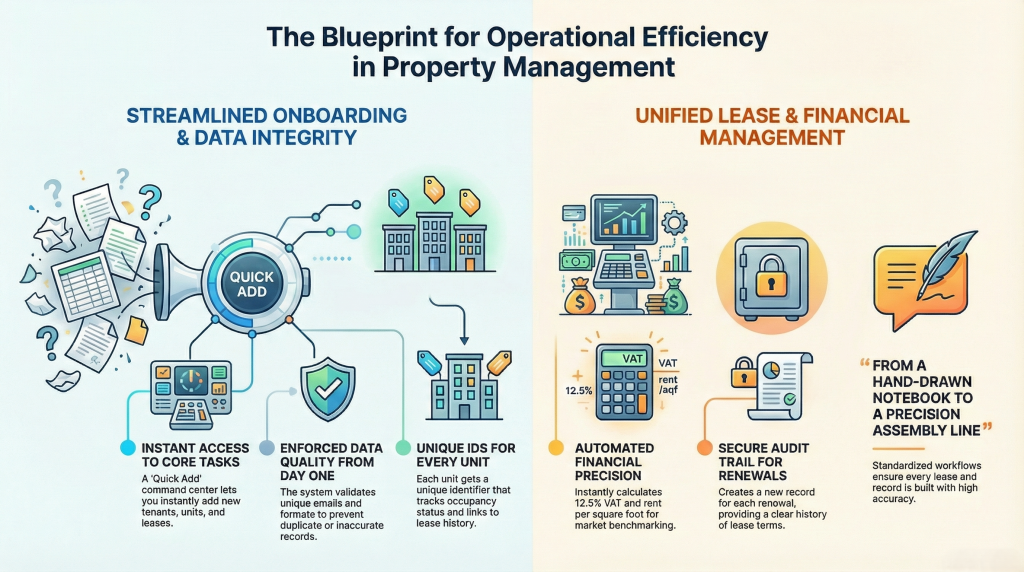
Excellence in property management requires consistency, and consistency requires structure. RMAS brings standardized workflows to every critical operational task, ensuring that tenant onboarding, lease creation, unit management, and financial tracking follow proven processes that minimize errors and maximize efficiency.
The Quick Add feature on the Home Page provides instant access to the three most common property management tasks: adding new tenants, creating new units, and establishing new leases. This eliminates the navigation friction that typically characterizes database-driven systems, allowing your team to respond immediately when a prospective tenant walks through the door or when you acquire a new property.
Creating a new tenant record walks you through a structured form that captures essential information: tenant name, email address for digital communication, phone number, emergency contact details, and optional notes for recording move-in dates, payment preferences, or special requirements. The system enforces data quality by validating email formats, and data inconsistencies that plague spreadsheet-based systems.
Unit management follows similar principles of structured simplicity. Each unit receives a unique identifier that you define based on your property naming conventions, whether that’s simple numbering like “101” or more descriptive identifiers like “Commercial Unit 10, 209 Sq. Ft.” The system tracks occupancy status, links current tenants, and maintains a complete history of all leases associated with that unit. When you view a unit’s detail page, you see not only current information but also historical lease data, allowing you to analyse long-term performance trends for specific properties.
Lease management represents the operational core of rental property operations, and RMAS provides comprehensive capabilities for the entire lease lifecycle. Creating a new lease involves selecting the unit and tenant from dropdown lists populated with your existing records, then entering lease terms including start and end dates, financial information such as monthly rent amounts both VAT-exclusive and VAT-inclusive, unit square footage, and arrears information if the lease begins with existing debt. The system automatically calculates rent per square foot, providing instant feedback on whether your rental rate aligns with market expectations.
The platform’s approach to lease renewals demonstrates the system’s understanding of property management best practices. When a lease approaches expiration, you have two options. You can create an entirely new lease record that references the expiring lease, which maintains perfect historical accuracy and allows you to track how lease terms evolve over time. Alternatively, you can extend the existing lease by editing the end date, which works well for straightforward renewals without term changes.
Pro Tip: Consider creating a new lease record as the preferred approach for handling renewals. This approach allows you to maintain clear historical records, protects landlords in potential disputes, and provides valuable data for long-term strategic analysis.
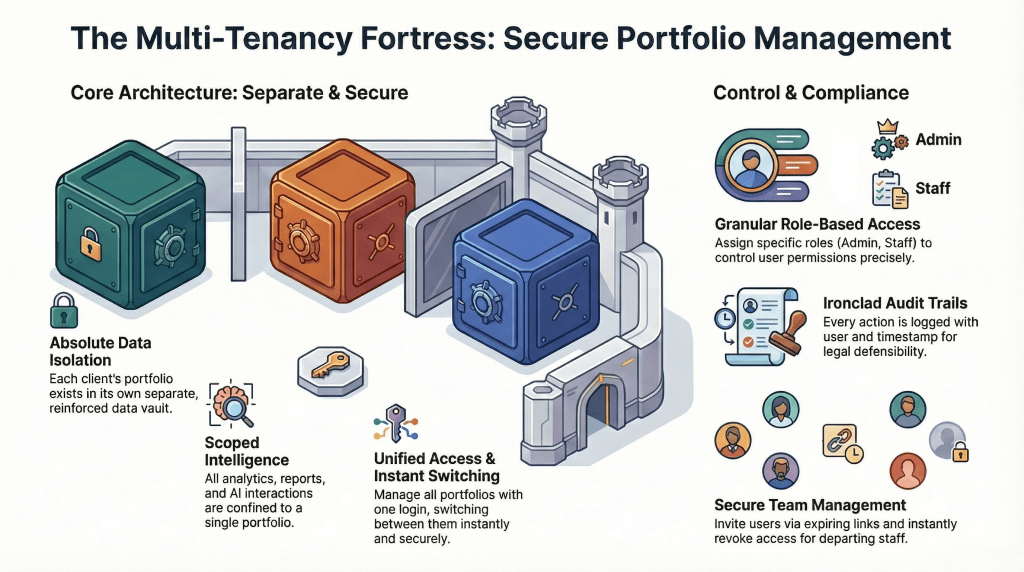
For property management companies and landlords managing multiple ownership portfolios, data isolation is not merely a convenience but a legal and ethical necessity. RMAS employs enterprise-grade multi-tenancy architecture that ensures absolute separation between different company portfolios while allowing authorized users seamless access to multiple organizations within a single account.
Each company in the system represents a distinct ownership entity with separate data. When you create tenants, units, and leases, those records belong exclusively to the currently selected company. All analytics, reports, and AI interactions are automatically scoped to that company’s data, preventing any possibility of cross-contamination between portfolios. This architecture is particularly valuable for property management firms that handle properties for multiple landlords, each of whom expects complete confidentiality regarding their portfolio performance and tenant information.
The company switcher interface makes moving between portfolios effortless. Users can click the Company Management dropdown in the navigation bar, select “All Companies”, and view cards for each organization where they have access. Clicking “Switch to This Company” instantly reloads the entire interface with that company’s data, confirmed by both a visual change in the displayed company name and a notification message indicating the successful switch. From that moment forward, every feature on the platform, from the Home Page to Analytics Dashboards, Data Management, and Lumin AI conversations are all scoped and operate exclusively within the context of that selected company.
Role-based access control provides granular permission management within each company. The system supports three primary user roles with distinct capabilities. Company Administrators possess full access to create, edit, and delete all data, manage team members, access all reports, and modify company settings. This role is appropriate for property management company owners and senior managers who need unrestricted control. Company Staff can create, edit, and delete units, tenants, and leases, and view all reports, but cannot manage users or modify company-level settings. This role suits property managers and administrative staff who handle day-to-day operations. Tenant Users have read-only access to their own lease information.
This security model ensures that team members have exactly the access they need to perform their responsibilities, nothing more and nothing less. When a staff member leaves your organization, deactivating their account immediately revokes all access while preserving the historical record of their activities within the system. When you onboard a new team member, you can invite them via email with a secure link that expires after seven days, and they join the appropriate company with the permissions assigned to their role.
The implications for compliance are significant. Trinidad and Tobago’s legal framework for property management, Data Protection, and Anti-Money Laundering is increasingly evolving with an emphasis on proper record-keeping, privacy, and data protection. When handling multiple ownership portfolios, the ability to demonstrate clear data separation and access controls provides both operational security and legal defensibility. RMAS’ multi-tenancy architecture positions property managers to meet both current and future regulatory requirements as data protection standards continue to evolve.
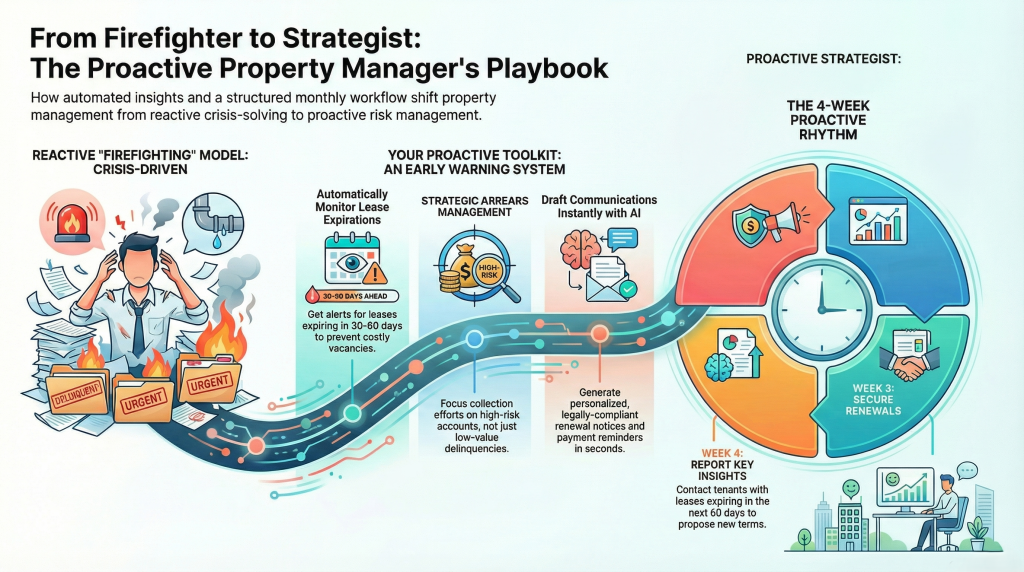
The most expensive problems in property management are the ones you discover too late. A lease that expires without renewal can lead to lost rental income and unexpected vacancy costs. Arrears that accumulate for months before intervention dramatically reduces collection probability and strains tenant relationships. RMAS transforms landlords and property managers from reactive firefighting constantly addressing crises to proactive strategists equipped with the capabilities to identify issues and address challenges optimally.
The system automatically monitors your lease portfolio and identifies agreements expiring within the next thirty to ninety days. Rather than maintaining manual spreadsheets with lease expiration dates or relying on memory, landlords and property managers receive systematic alerts that allow ample time to initiate renewal discussions, assess market conditions, and determine appropriate rent adjustments. The Leases List page includes a filter specifically for “Expiring Soon” status, allowing you to view all at-risk leases in a single list and prioritize renewal outreach efforts.
This automated lease monitoring is particularly valuable given the lengthy legal eviction process in Trinidad and Tobago. It is illegal for a landlord to evict a tenant without a court order, even in cases of prolonged non-payment. As such, identifying lease expiration risks early allows property owners and managers to negotiate renewals or identify replacement tenants before vacancy occurs.
Arrears management receives similar proactive treatment. The platform’s Status indicators automatically flag tenants who have fallen behind on rent payments, and the Arrears Analytics Dashboard provides complete visibility into the scale and distribution of delinquency across your portfolio. You can instantly see which tenants owe the most, as well as the number of months each tenant is in arrears. This visibility enables strategic collection decisions rather than generic approaches that waste resources on low-value accounts while high-risk situations deteriorate.
Lumin AI amplifies these proactive capabilities by enabling landlords and property managers to quickly draft personalized communications based on tenant-specific circumstances. Users can ask Lumin to generate a renewal notice for a specific tenant that references their perfect payment history and proposes a modest rent increase aligned with market conditions. You can request arrears reminder letters that strike an appropriate tone based on the tenant’s historical relationship with your organization. This AI-assisted communication transforms what would be hours of manual drafting into a review-and-send process that takes minutes.
The monthly operational cadence recommended in the RMAS User Guide reflects this proactive philosophy. Week one focuses on arrears analysis and management, identifying high-risk accounts and initiating collection efforts. Week two emphasizes performance analysis, reviewing analytical dashboards to identify trends and compare current results against historical benchmarks. Week three concentrates on renewal management, contacting tenants with leases expiring in the next sixty days and preparing renewal offers. Week four involves compiling management reports and using Lumin AI to help draft executive summaries. This structured approach ensures that critical activities happen on schedule rather than in response to crises.
While the five pillars provide the architectural foundation, it’s the practical application of these capabilities to daily property management tasks that delivers tangible value. RMAS excels at managing the complete property lifecycle from initial unit registration through tenant onboarding, lease creation, payment tracking, and eventual tenant turnover.
Every property portfolio begins with physical units, and RMAS provides comprehensive unit management capabilities that go far beyond simple address lists. The Units page displays key metrics, including your total unit count, the number of occupied units, and the number of vacant units available for rent. The main units table shows each unit’s identifier, description, tenancy status, current tenant if occupied, and action buttons for viewing details, editing information, or deleting the record.
The search and filter capabilities on the Units page enable users to quickly navigate large portfolios. Users can search by unit identifier, description, or tenant name, with results updating in real-time as you type. Status filters allow you to view all units, only active units with tenants in good standing, only evicted tenants, only inactive units where tenants occupy space without current lease agreements, or only vacant units ready for new tenants. This filtering is particularly valuable when preparing units for marketing or conducting portfolio-wide audits of occupancy status.
When you view a unit’s detail page, you see comprehensive information organized into four sections. The Unit Information section displays the unit identifier, description, tenancy status, current tenant details, company ownership, and unit square footage. The Active Leases section lists all current lease agreements associated with the unit, including start and end dates, monthly rental amounts, and action buttons to view full lease details. The Quick Stats section provides at-a-glance metrics including status, active lease count, total historical lease count, and current monthly rent. The Record Information section shows audit trail data, including who created the record, when it was created, who last modified it, and when that modification occurred.
This comprehensive unit view enables you to quickly understand both the current state and historical performance. When considering whether to increase rent on a particular unit, you can review the complete lease history to see how rental rates have evolved over time and whether previous increases correlated with tenant turnover. When a prospective tenant asks about a unit’s availability, you can immediately see not only vacancy status but also details about the space that inform your marketing conversation.
Tenant Management: Building Relationships Through Data
Strong tenant relationships begin with organized information. The Tenants page provides similar capabilities to the Units page, displaying total tenant count and active tenant metrics, along with a comprehensive table of all tenant records showing names, email addresses, phone numbers, the number of active leases, portal access status, and action buttons.
Creating a new tenant record captures essential contact information along with optional but recommended details like contact and emergency contact information and notes about payment preferences or special requirements. When you link a tenant record to a user account, you enable future portal access capabilities that will allow tenants to view their lease information, submit maintenance requests, and potentially make online rent payments.
The Tenant Detail page provides a complete view of each tenant relationship, organized into four sections. Contact Information shows full name, email, phone, emergency contact, and user account status. Financial Information summarizes total monthly rent across all units and outstanding arrears, if applicable. The Leases section lists all active and historical lease agreements for this tenant, showing which units they occupy, lease dates, rental amounts, arrears, and action buttons to view lease details. The Occupied Units section displays all units currently rented by this tenant with unit identifiers, descriptions, status, and action buttons to view unit details.
This consolidated tenant view is invaluable when tenant issues arise. If a tenant calls with questions about their lease terms, you pull up their detail page and have instant access to all relevant information without searching through multiple systems or file folders. Landlords and property managers seeking to renew lease agreements can see whether a tenant is in good standing across all their rental relationships with your organization prior to executing lease renewals.
Lease Management: The Operational Core
Lease agreements represent the legal and financial foundation of rental relationships, and RMAS provides comprehensive lease management that handles the complete agreement lifecycle. The Leases page displays critical portfolio metrics, including total lease count, active leases with end dates on or after today, leases expiring soon within the next thirty days, and expired leases that have ended.
Creating a new lease begins with selecting a unit and tenant from dropdown lists, ensuring that the agreement links properly to existing records. You then enter lease terms, including start and end dates, with validation ensuring the end date occurs after the start date. Financial Information includes monthly rent, both VAT-exclusive and VAT-inclusive, with the system automatically calculating the difference as the VAT amount. You enter the unit square footage, and RMAS calculates rent per square foot.
Arrears Information can be captured at lease creation if a tenant is transferring existing debt from a previous lease or added later as arrears accumulate. Additional lease information that can be added includes the number of months in arrears, and arrears expressed in years, and as a proportion of your total portfolio arrears. These multi-dimensional arrears tracking enables both absolute and relative risk assessment.
The Lease Detail page provides comprehensive information organized into five sections. Lease Information displays the unit, tenant, lease start and end dates, lease term in years, and unit size. Financial Information shows monthly rent VAT-exclusive and VAT-inclusive, the exact VAT amount and percentage, and rent per square foot. Arrears Information presents outstanding arrears, months in arrears, and the proportion this represents of total portfolio arrears. Quick Stats shows status, remaining months until expiration for active leases, monthly rent, and arrears balance. Record Information provides the audit trail of when the lease record was created and modified.
This detailed lease view supports both operational efficiency and legal defensibility. When preparing for lease renewal negotiations, landlords and property managers have all relevant financial information at hand. If a tenant disputes their arrears balance, you can show exactly when the debt was recorded and by whom. If you need to provide documentation for legal proceedings, whether eviction actions or debt collection through the Landlord and Tenant Ordinance, Rent Restriction (Dwelling Houses) Act, or Land Tenants (Security of Tenure) Act for distress remedy, you can export comprehensive lease data or capture screenshots of the complete record.
Financial Intelligence: Revenue and Arrears Tracking
Property management ultimately comes down to financial performance, and RMAS provides robust capabilities for tracking both rental income and arrears. The platform automatically handles Trinidad and Tobago’s 12.50% VAT, calculating both VAT-inclusive and VAT-exclusive amounts and clearly displaying both figures throughout the system. This automatic VAT handling eliminates calculation errors and ensures accurate financial reporting for both internal management and statutory compliance.
Given the significance of rent collection challenges in the Trinidad and Tobago market, delinquency management represents a critical capability for any landlord or property manager. RMAS provides complete visibility into arrears distribution across your portfolio, enabling you to identify high-risk accounts and prioritize collection efforts strategically.
The system tracks arrears at the lease level, recording total amounts owed, months in arrears, years in arrears, and the proportion each debt represents of your total portfolio arrears. This proportional tracking is particularly valuable for large portfolios where absolute arrears amounts can be misleading. A tenant owing five thousand dollars might represent your highest-priority collection target if your total portfolio arrears is twenty thousand dollars but might be a secondary concern if your total arrears is two hundred thousand dollars. The proportional view provides this relative risk context automatically.
While RMAS currently requires manual updating of arrears amounts when payments are received, the structured approach significantly improves accuracy compared to spreadsheet tracking. When a tenant makes a partial payment, you navigate to the lease record, click edit, adjust the arrears amount by subtracting the payment, recalculate months in arrears, and save the lease. This creates an audit trail showing when the balance was updated and by whom, supporting both internal controls and potential legal proceedings.
Innovation Spotlight: Lumin AI as Your Property Management Co-Pilot
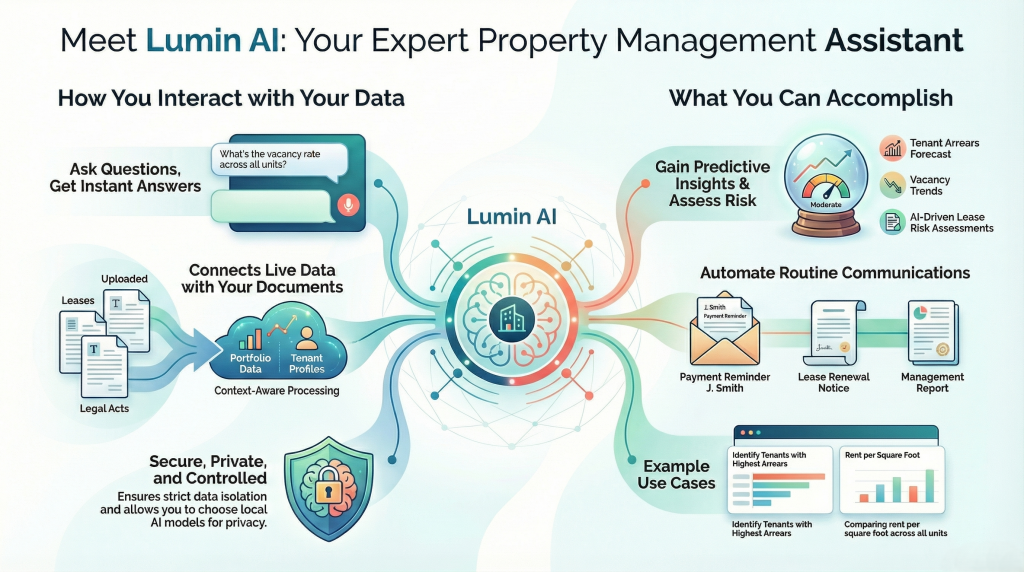
While all RMAS’s capabilities deliver significant value, Lumin AI represents a paradigm shift in how landlords and property managers interact with their data and make decisions. Rather than forcing you to learn complex database query syntax or build elaborate spreadsheet formulas, Lumin allows you to simply ask questions in plain English and receive intelligent answers that combine your property data with uploaded documents and contextual understanding.
The practical applications span every aspect of property management. During their week one arrears management focus, landlords and property managers can ask Lumin “Which tenants have arrears exceeding three months and what are their unit locations?” and receive an immediate answer formatted as a clear table. During week two performance analysis, users can inquire “How does the average rent per square foot in my commercial units compare to my residential units?” and get comparative statistics. During week three renewal management, users can request “Generate a lease renewal offer letter for the tenant in Unit 204 that includes a five percent rent increase and references their excellent payment history” and receive a draft ready for your review.
The Retrieval-Augmented Generation technology that powers Lumin AI creates particularly powerful capabilities when analysing legal documents and lease agreements. Property management in Trinidad and Tobago requires navigation of multiple regulatory frameworks. Rather than manually searching through these documents when questions arise, landlords and property managers can upload PDF copies to RMAS and ask Lumin to analyse specific situations in light of the relevant legal provisions.
Consider a scenario where a tenant has fallen significantly behind on rent and you are considering pursuing distress proceedings to levy upon items in the tenanted premises. You upload the Landlord and Tenant Ordinance to RMAS, then ask Lumin “What are the legal requirements for pursuing distress for rent arrears under the Landlord and Tenant Ordinance, Rent Restriction (Dwelling Houses) Act, and Land Tenants (Security of Tenure) Act? Lumin analyses the documents, extracts the relevant provisions, and provides a summary of the requirements and procedures. You then follow up with:
“Based on my lease agreement for Unit 305 and the tenant’s current arrears of eight thousand dollars across four months, draft a notice of intent to pursue distress proceedings.”
and Lumin generates a document that incorporates specific lease terms, current arrears data, and appropriate legal language.
This fusion of legal document intelligence and live operational data creates capabilities that would require significant legal expense or extensive manual research to achieve otherwise. For individual landlords who cannot afford to consult attorneys on every decision, Lumin provides accessible information grounded in actual legal texts. For property management companies with legal departments, Lumin accelerates research and document drafting, allowing attorneys to focus on complex cases while routine matters are handled efficiently.
The local processing architecture that keeps all data within your secure environment addresses a critical concern in property management. Tenant information is highly sensitive, and many landlords rightly hesitate to adopt technology solutions that transmit data to external servers for processing. RMAS uses Small Language Models (SLMs) running locally. This means your tenant data, financial information, and proprietary documents never leave our infrastructure. You get leading-edge artificial intelligence capabilities without compromising data security or privacy.
The model selection capabilities provide flexibility based on your specific needs. For quick responses on straightforward questions, the Gemma and Qwen models provide fast turnaround. For complex analytical questions that require deeper reasoning, the Llama and Phi4 Reasoning Plus models deliver more sophisticated analysis at the cost of slightly longer processing time. As your needs evolve, you can adjust model selection to optimize the balance between response speed and analytical depth.
Future releases will integrate premium models from major artificial intelligence providers including GPT-5 models from OpenAI, Claude Sonnet and Opus models from Anthropic, and Gemini Flash and Pro models from Google. These integrations will provide access to the most advanced language models available while maintaining your ability to use local models when data security requirements demand it. This flexible architecture provides the best of both worlds of security and data privacy along with access to state-of-the-art models to landlords and property managers.
Professional Collaboration and Security: Built for Teams
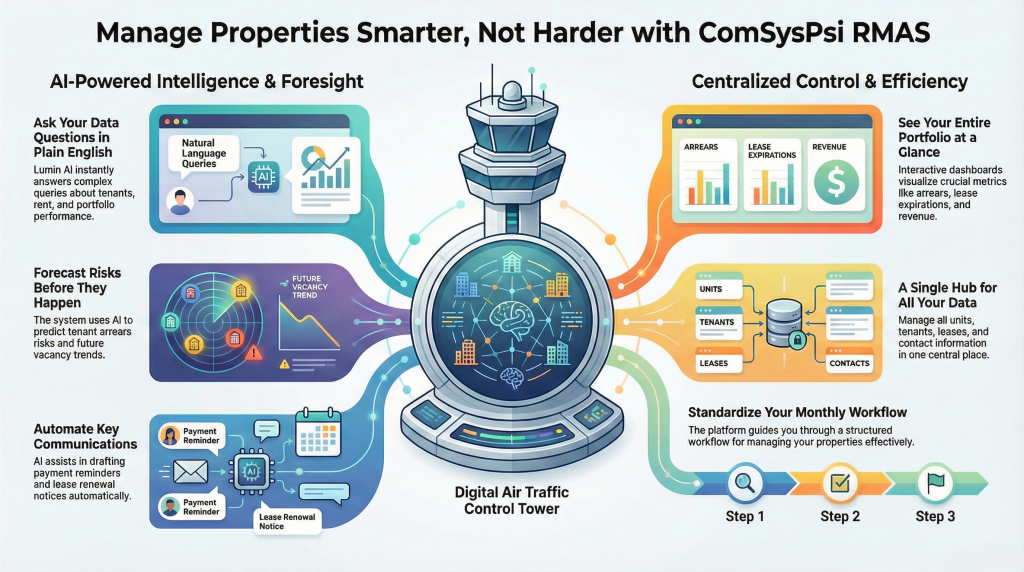
Property management is rarely a solo endeavour, and RMAS provides comprehensive team collaboration capabilities designed for both individual landlords working with assistants and large property management firms with multiple staff members. The multi-tenancy architecture and role-based access control combine to create a secure, scalable foundation for team-based operations.
Company Administrators have complete control over team composition. From the Company Settings interface, administrators can invite new team members by entering their email address, selecting their role as either Company Administrator or Company Staff, and optionally including a personalized message in the invitation. The system sends a secure email link that expires after seven days, allowing recipients to click the link to create their account and immediately gain access to the appropriate company with assigned permissions.
The invitation management system provides full visibility and control. Administrators can view all pending invitations, resend expired invitations if the recipient didn’t respond within the seven-day window, revoke invitations if circumstances change, and copy invitation links to share through alternative communication channels. When team members leave your organization, administrators can deactivate their accounts to immediately revoke access while preserving the complete audit trail of their activities within the system.
The role-based permission model ensures that team members have exactly the access they need to perform their responsibilities. Company Staff can create, edit, and delete units, tenants, and leases, and can view all analytical reports and dashboards. They can manage the complete day-to-day operations of property management without the ability to modify company-level settings or team composition. This separation of operational and administrative permissions provides appropriate delegation while maintaining control over critical configuration decisions.
For firms managing multiple ownership portfolios, the multi-tenancy architecture’s support for users belonging to multiple companies creates powerful workflow capabilities. A property manager who handles properties for three different landlords can access all three portfolios from a single user account, switching between them instantly via the Company Management interface. Each landlord sees only their own properties and data, maintaining complete confidentiality, while the property manager enjoys the efficiency of a unified working environment.
The audit trail capabilities woven throughout RMAS support both accountability and compliance. Every record in the system tracks who created it and when, and who last modified it and when. When disputes arise or questions emerge, you can trace exactly when information was entered or changed and by whom. This transparency builds trust within teams and provides documentation that can be invaluable in legal proceedings or regulatory inquiries.
Getting Started: Your Path to Intelligent Property Management
The transition from spreadsheet-based management to an integrated intelligence platform like RMAS begins with a straightforward registration process. For landlords and property managers seeking early access to the platform’s most advanced capabilities, joining the waitlist provides priority notification when new features and premium tiers become available. The waitlist signup captures your interest and ensures you are among the first to experience new features as they are released.
The Caribbean Advantage: Built for Local Context

ComSysPsi RMAS distinguishes itself from generic international property management platforms through its deep understanding of the Caribbean market context. The development team comprises Caribbean software engineers and artificial intelligence specialists who understand not just the technical requirements of property management, but the commercial and analytic requirements. The team also includes real estate professionals with deep understanding of the specific regulatory environment, market dynamics, and practical challenges faced by Trinidad and Tobago landlords and property managers.
The automatic VAT handling allows landlords and property managers to track rental income as both VAT-inclusive and VAT-exclusive amounts for reporting and compliance purposes. RMAS builds this VAT calculation directly into the lease management workflow, eliminating manual calculations and reducing the risk of errors that could create compliance issues or financial discrepancies.
The platform’s document analysis capabilities through Lumin AI represent a particularly valuable feature. The ability to upload copies of specific legislation, regulations, and guidelines, and custom or standard lease agreements, then query Lumin AI about specific provisions and their application to particular situations, transforms legal research from a time-consuming specialized task into an accessible everyday tool.
Currency considerations receive appropriate treatment within RMAS. While most rental agreements in Trinidad and Tobago are structured in Trinidad and Tobago Dollars (TTD), the rental market exhibits hybrid pricing behavior. High-end residential properties are often quoted in United States Dollars (USD), particularly when targeting expatriate tenants or international executives. Commercial properties may similarly use USD pricing in marketing materials while collecting rent in Trinidad and Tobago Dollars at prevailing exchange rates. RMAS accommodates these market realities through its flexible data entry and the analytical capabilities of Lumin AI, which can work with multiple currency contexts when analysing your portfolio data.
The local market’s structural characteristics also inform RMAS’ design. The sustained weakness in commercial real estate following the 2014 oil price collapse, the shift toward hybrid work arrangements accelerated by the pandemic, and the competitive pressure driving landlords to offer unprecedented concessions all create an environment where data-driven decision making is critical. When vacancy rates approach twenty-five percent in some commercial markets and rental rates have declined by one-third from peak levels, landlords cannot afford reactive management based on incomplete information and delayed insights.
Pro-Tips: Best Practices from the Field
Drawing from the RMAS user guide and best practices developed through platform development, several strategic recommendations can maximize your success with RMAS.
- Create new lease records for renewals rather than extending existing leases: While the system allows you to simply edit an existing lease and update the end date when a tenant renews, this approach obscures your historical data. Creating a new lease record that begins the day after the previous lease expires maintains clear documentation of how lease terms have evolved over time. If a tenant’s rent increases from three thousand to three thousand one hundred and fifty dollars upon renewal, separate lease records show this change explicitly. In the event of future disputes or legal proceedings, this historical clarity can prove invaluable.
- Use the Notes field extensively during initial system setup: As you migrate from spreadsheets and paper files, capture institutional knowledge that exists only in people’s heads or scattered emails. Did you verbally agree to let a tenant pay on the fifteenth rather than the first due to their payroll schedule? Record it in the tenant’s notes. Does a particular unit have a history of plumbing issues that prospective tenants should know about? Note it in the unit description or notes. This documentation prevents knowledge loss when team members transition and creates a comprehensive organizational memory.
- Export analytical data regularly for offline backup and external analysis: While RMAS provides robust reporting capabilities, maintaining external copies of key data serves both disaster recovery and integration purposes. Export your tenant summary table and arrears analytics table monthly to CSV or Excel format and save these files to your organization’s backup systems. If you use external accounting software for financial consolidation, these CSV or Excel exports provide clean data feeds. If you need to create custom reports not yet available in RMAS, exported data gives you the raw material for spreadsheet-based analysis while you request new features from the development team.
- Develop a monthly operational cadence and schedule recurring calendar reminders: The recommended four-week cycle of arrears management, performance analysis, renewal management, and reporting provides structure that prevents critical tasks from falling through cracks. Block time on your calendar for these activities just as you would block time for property inspections or tenant meetings. Consistency in analytical review enables trend spotting that would be invisible with sporadic, reactive analysis.
- Leverage Lumin AI for communication drafting rather than starting from blank pages: Whether you’re composing lease renewal notices, arrears reminder letters, or welcome messages to new tenants, starting with AI-generated drafts accelerates the process and often produces better results than manual composition. You provide Lumin with context about the specific tenant and situation, review the generated draft, and modify as needed to match your voice and specific circumstances. This workflow transforms a thirty-minute task into a five-minute review process while often producing more thorough communication than you might compose manually.
- Use the search and filter capabilities extensively rather than scrolling through full lists: As your portfolio grows, the ability to quickly narrow displayed data becomes increasingly valuable. Rather than paging through twenty screens of leases looking for agreements expiring soon, use the status filter. Rather than scanning a hundred tenant records looking for a specific name, use the search bar. These tools exist precisely to make large datasets manageable and developing the habit of filtering before browsing saves time and reduces errors.
Monthly Operational Cadence: Your Strategic Rhythm
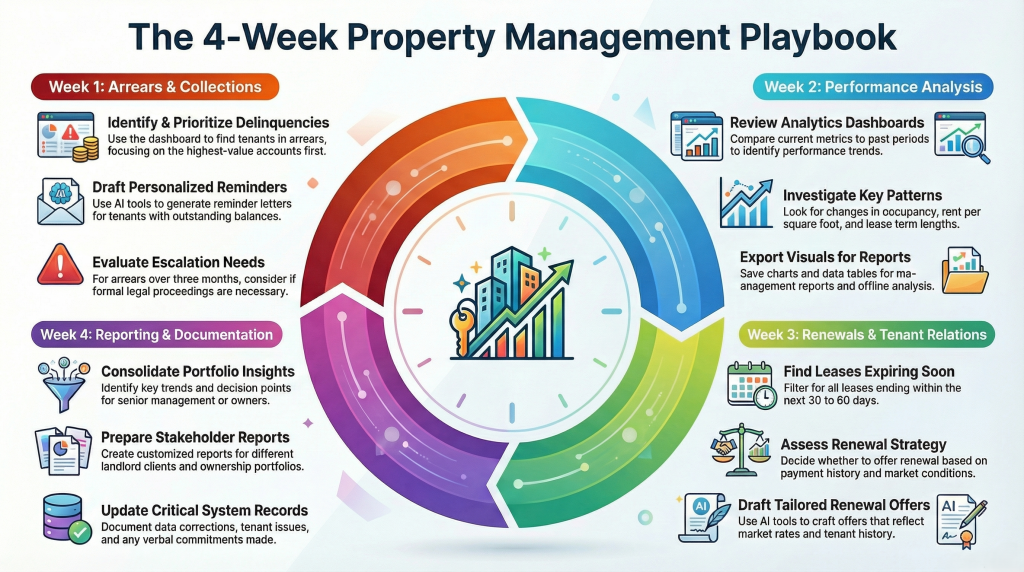
Property management excellence requires consistent execution of critical activities, and RMAS supports this through a recommended monthly operational cadence that ensures nothing falls through the cracks.
- Week One: Arrears Analysis and Management: The first week of each month focuses on identifying and addressing delinquencies. Visit the Analytics Dashboard to review the arrears metrics displayed in the top cards, showing total arrears across your portfolio and how that amount has changed from the previous month. Review the Tenant Summary table to identify tenants flagged with arrears status, sorting by arrears amount to prioritize collection efforts on the highest-value accounts. For each tenant in arrears, click through to view their complete detail page and active leases. Review the arrears information section of their lease records to see exactly how many months behind they’ve fallen. Use Lumin AI to draft personalized reminder letters that acknowledge the tenant’s history with your organization while clearly stating the outstanding balance and payment expectations. For tenants with arrears exceeding three months, consider whether escalation to formal legal proceedings may be necessary.
- Week Two: Performance Analysis and Strategic Review: The second week emphasizes analytical review of portfolio performance. Visit each of the specialized analytics dashboards in sequence, starting with the main dashboard, then progressing through Arrears Analytics, Lease Term Analytics, Rent Per Square Foot Analytics, and Unit Size Analytics. For each dashboard, compare current metrics to the previous month, previous quarter, and previous year to identify trends. Look for patterns that warrant investigation. Has average rent per square foot declined, suggesting market weakness that requires rental rate adjustments? Has the proportion of leases with terms shorter than one year increased, potentially signaling tenant uncertainty about market conditions? Have occupancy rates improved or deteriorated, and does the change correlate with specific properties or unit types? Export the chart visualizations and data tables for offline analysis and inclusion in management reports.
- Week Three: Renewal Management and Tenant Relations: The third week concentrates on proactive lease management. Navigate to the Leases page and apply the “Expiring Soon” filter to identify all leases ending within the next thirty days. For each expiring lease, review the tenant’s payment history and assess whether you wish to offer renewal. For tenants you want to retain, use Lumin AI to quickly identify appropriate renewal terms and draft renewal offer letters. Ask Lumin questions like “Generate a table of all leases expiring in the next thirty, sixty-, and ninety-days including tenant names, lease start and end dates, monthly rent VAT-inclusive, and arrears amounts.” Review the results to prioritize your renewal outreach based on property importance and tenant quality. When drafting renewal offers, consider current market conditions. If you’re managing commercial properties in a market with high vacancy rates and declining rental rates, aggressive rent increases may drive good tenants to relocate. If you’re managing residential properties in high-demand areas, market conditions may support rent increases that recalibrate below-market leases. Use Lumin AI to help craft communications that acknowledge tenant relationships while clearly stating new terms: “Draft a lease renewal offer for the tenant in Unit 402 that proposes a three percent rent increase, references their excellent five-year payment history, and emphasizes the property improvements we’ve made during their tenancy.”
- Week Four: Management Reporting and Strategic Documentation: The fourth week focuses on consolidating insights and preparing reports. Review the overall portfolio statistics across all dashboards, identify key trends and decision points that warrant senior management or ownership attention, and use Lumin AI to help draft monthly summary reports. Export key chart visualizations and data tables for inclusion in reports or presentations to stakeholders. For property management companies reporting to multiple landlord clients, prepare customized reports for each ownership portfolio by switching company context and generating tailored exports. For individual landlords, compile information needed for tax preparation, financial planning, or strategic decision making about property sales or acquisitions. Use this week to update any critical documentation that emerged during the previous three weeks. If you discovered discrepancies between your RMAS data and external records, investigate and correct them. If tenants reported unit issues that require documentation, ensure notes are added to the appropriate records. If you made verbal commitments to tenants about maintenance or lease modifications, document those commitments in the system before they’re forgotten.
Conclusion: The Architecture of Excellence

Property management in Trinidad and Tobago stands at a crossroads. The economic pressures that have reshaped the rental market since 2014, the structural shifts accelerated by the pandemic, and the persistent challenges of arrears management and regulatory compliance create an environment where operational excellence is not merely desirable but essential for survival. The days when landlords and property managers could succeed through passive management and reactive problem-solving have ended. The future belongs to those who architect their portfolios as high-performance systems rather than managing them as collections of independent transactions.
RMAS represents this fundamental transformation. It is not property management software in the traditional sense of digital record-keeping that simply replaces paper files with database entries. It is an intelligent unified data management platform that brings the power of artificial intelligence, real-time analytics, standardized workflows, enterprise security, and proactive risk management to bear on every dimension of property operations.
The integrated nature of RMAS’ five pillars creates capabilities that exceed the sum of their parts. AI-driven decision support becomes more powerful when it operates on structured data maintained through standardized workflows. Real-time analytics deliver greater insight when they’re secured through multi-tenancy architecture that ensures data integrity. Proactive risk management is more effective when it draws on the comprehensive portfolio view that unified data management provides. This integration transforms property management from a series of discrete tasks into a coherent system where every component reinforces the others.
For individual landlords managing residential properties, RMAS provides the organizational capabilities and analytical insights that previously required hiring professional property management companies. You gain visibility into your portfolio performance, systematic approaches to tenant management and arrears collection, and AI-powered assistance that makes complex analysis accessible. The monthly operational cadence gives you a proven framework for staying ahead of problems rather than constantly reacting to crises.
For property management companies handling multiple ownership portfolios, RMAS delivers the enterprise-grade capabilities needed to scale operations while maintaining service quality. The multi-tenancy architecture ensures absolute data isolation between clients while allowing your team to work efficiently across portfolios. The role-based access control enables appropriate delegation without compromising security. The comprehensive audit trails support accountability and compliance in an increasingly regulated environment.
The platform’s Caribbean origins provide advantages that extend beyond technical features. The development team understands the unique dynamics of the Trinidad and Tobago market, from the hybrid currency pricing in high-end rentals to the practical implications of prevailing legislation. This contextual understanding manifests in features like automatic VAT calculation, document analysis capabilities designed for local legal frameworks, and analytical dashboards that address the specific performance metrics relevant to Caribbean property management.
As artificial intelligence continues advancing and the platform evolves with new features and model integrations, RMAS will grow more powerful without requiring you to migrate to entirely new systems. The upcoming integrations with GPT-5, Claude, and Gemini will bring leading-edge large language models to your property management workflows. The planned features for automated payment recording, tenant portal access, and enhanced collaboration tools will further streamline operations. But the fundamental architecture remains constant:
five integrated pillars working in concert to transform reactive property management into proactive portfolio architecture.
The question for Trinidad and Tobago landlords and property managers is not whether to adopt intelligent property management platforms. The question is when. Market conditions that have placed unprecedented pressure on rental operations while simultaneously making operational excellence more critical have created an environment where early adopters will enjoy significant competitive advantages. Those who continue relying on spreadsheets and manual processes will find themselves increasingly unable to compete with organizations that deploy AI-powered analytics and standardized workflows.
Your path to high-performance property management begins with a decision. Visit ComSysPsi RMAS to learn more. Join the Waitlist to ensure priority access to new features and premium capabilities as they are released. Transform your portfolio from a reactive collection of tenancies into a proactive, intelligent system architected for sustained excellence. For direct inquiries, contact us at solutions@swarmintelligia.com.
The future of property management has arrived. It’s time to architect your advantage.
About ComSysPsi RMAS
ComSysPsi RMAS (Rental Management & Analytics System) is an intelligent property management platform designed specifically for the Caribbean market by Swarm Intelligia Limited. The platform combines AI-powered decision support, real-time analytics, standardized workflows, enterprise-grade security, and proactive risk management into a unified system that transforms property portfolio operations.
ComSysPsi RMAS is GDPR-compliant and maintains enterprise-grade security and data privacy standards.
ComSysPsi is the research and development function of Swarm Intelligia. Our focus is on the advancement of scientific research and development in the areas of Advanced Analytics, Machine Learning, and Deep Learning across the Caribbean and Latin America.
Established in 2024, the function comprises researchers, scientists, engineers, and developers with expertise in Advanced Data Analytics, Machine Learning, Artificial Intelligence, and Application Development.